The Opportunity
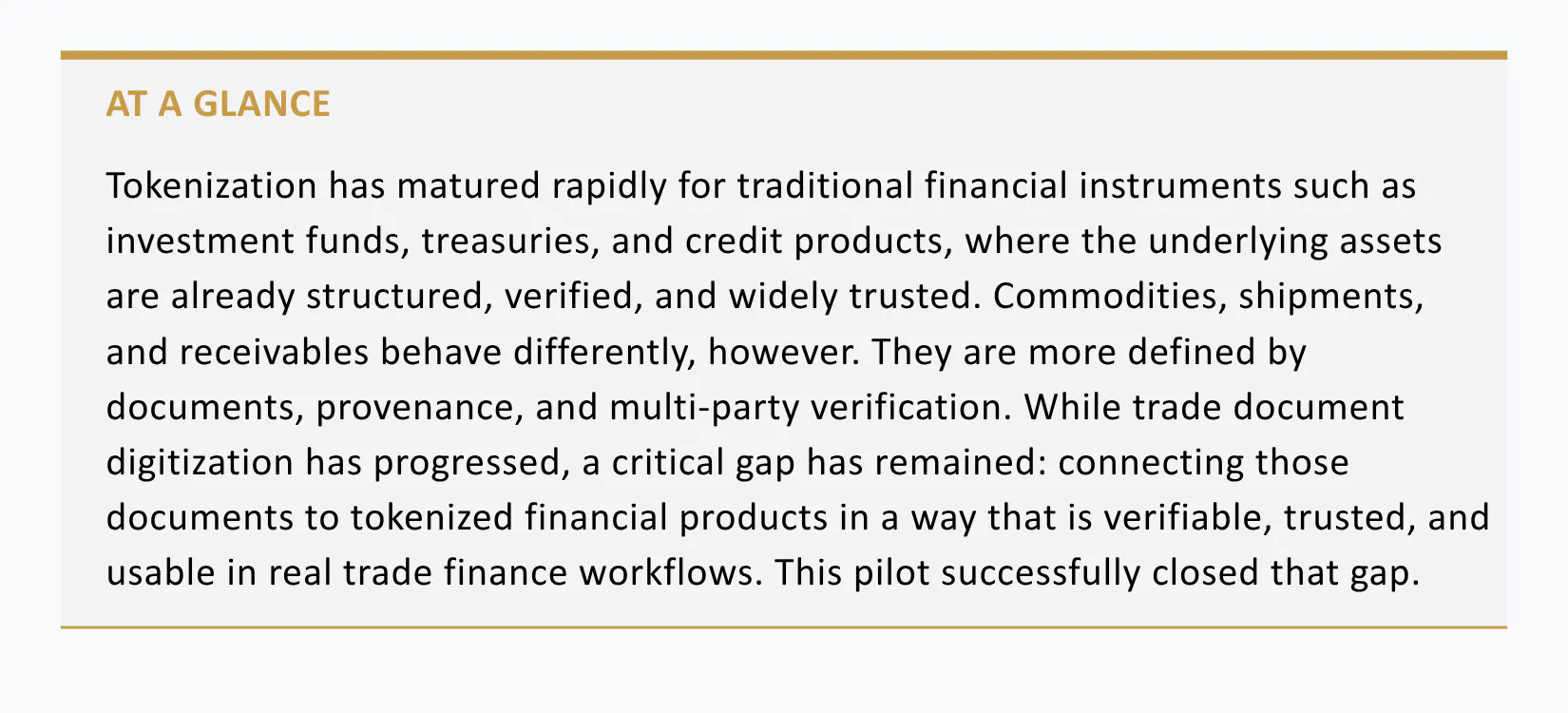
Tokenization has matured rapidly over the past several years, but the momentum has been concentrated in a familiar place—traditional financial instruments. Tokenized funds, treasuries, and credit products dominate the conversation because their underlying assets are already structured, verified, and widely trusted. The plumbing for moving such instruments on-chain has improved dramatically.
What remains less developed is the foundation beneath tokenized assets, particularly when those assets originate in the physical economy. Commodities, shipments, and receivables are defined by documents, provenance, and multi-party verification. A bag of cacao does not become a tokenized receivable simply because someone says it does. It becomes one when the farm that grew it, the shipment that carries it, the contract that sells it, and the buyer that receives it can all be traced and trusted.
Substantial progress has been made digitizing trade documents themselves. The unresolved gap, however, lies in connecting those documents to tokenized financial products in a way that is verifiable, trusted, and usable in real trade finance workflows. This straightforward but consequential observation became the focus of the pilot described below.
Participants
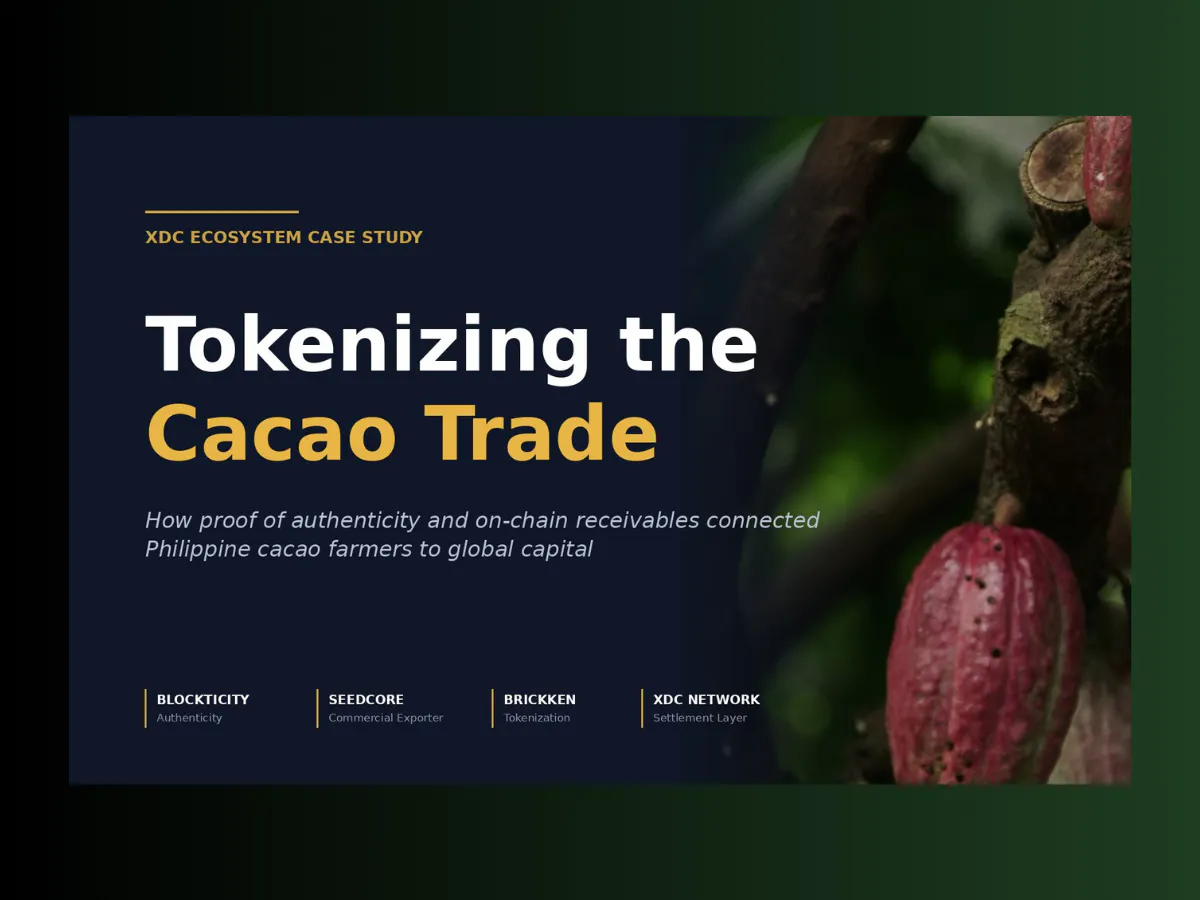
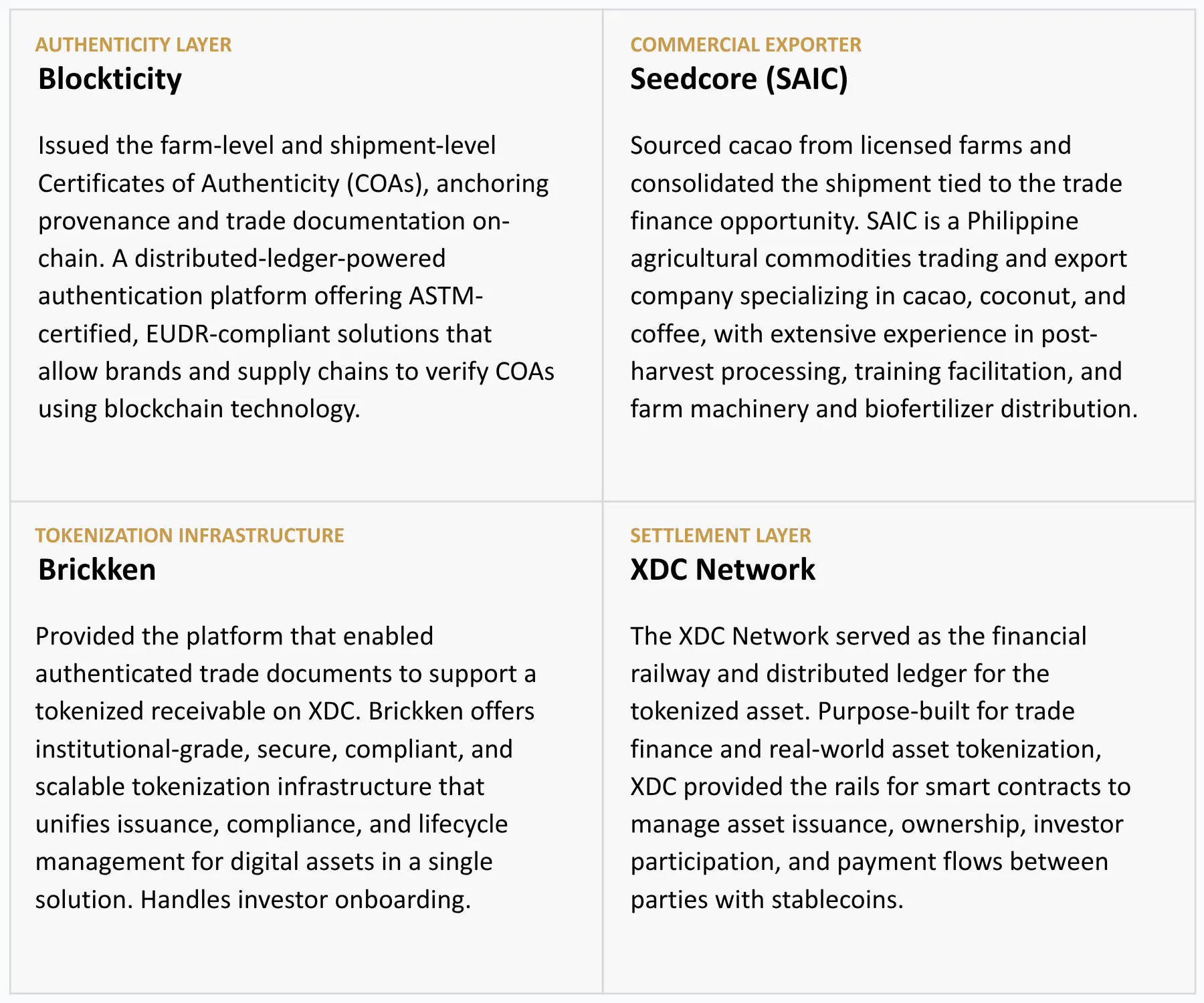
The pilot brought together four organizations, each contributing a distinct layer of the workflow. Together they form a stack in which physical provenance, commercial activity, financial structuring, and on-chain settlement are linked rather than siloed.
Process, Flows, and Outcomes
The workflow began at the ground level. Blockticity issued farm-level Certificates of Authenticity (COAs) for the licensed cacao farms supplying the crop. These COAs established an on-chain record of the upstream production sources behind the shipment — an auditable foothold tying the eventual financial instrument back to specific, verified producers.
After Seedcore sourced and consolidated cacao from those verified farms, Blockticity issued a shipment-level COA for the export batch. That shipment COA referenced the underlying farm COAs and linked the cacao consignment to its origin, supplier, buyer, contract details, and related trade documentation. The result was a single on-chain record that resolved cleanly from farmer to export shipment.
In parallel, XDC Foundation worked with Brickken to establish the financial layer. The authenticated COA and supporting trade documents were uploaded to Brickken's platform as part of the offering setup, and the required onboarding and compliance steps were completed there so the offering could be created and tested. From there, a tokenized receivable was deployed on the XDC Network, supported by the authenticated documentation tied to the underlying cacao shipment. Investors onboard to the Brickken platform, which also manages the lifecycle of the tokenized asset.
The Connection That Mattered
The defining feature of the pilot was the relationship between the two layers. Rather than duplicating data or bridging assets directly, the tokenized asset on XDC referenced authenticated records created by Blockticity. This allowed participants to review and verify the link between the financial instrument and the underlying cacao shipment before participating — a meaningful shift from the typical pattern, in which investors must take provenance largely on faith.
The Workflow, Step by Step
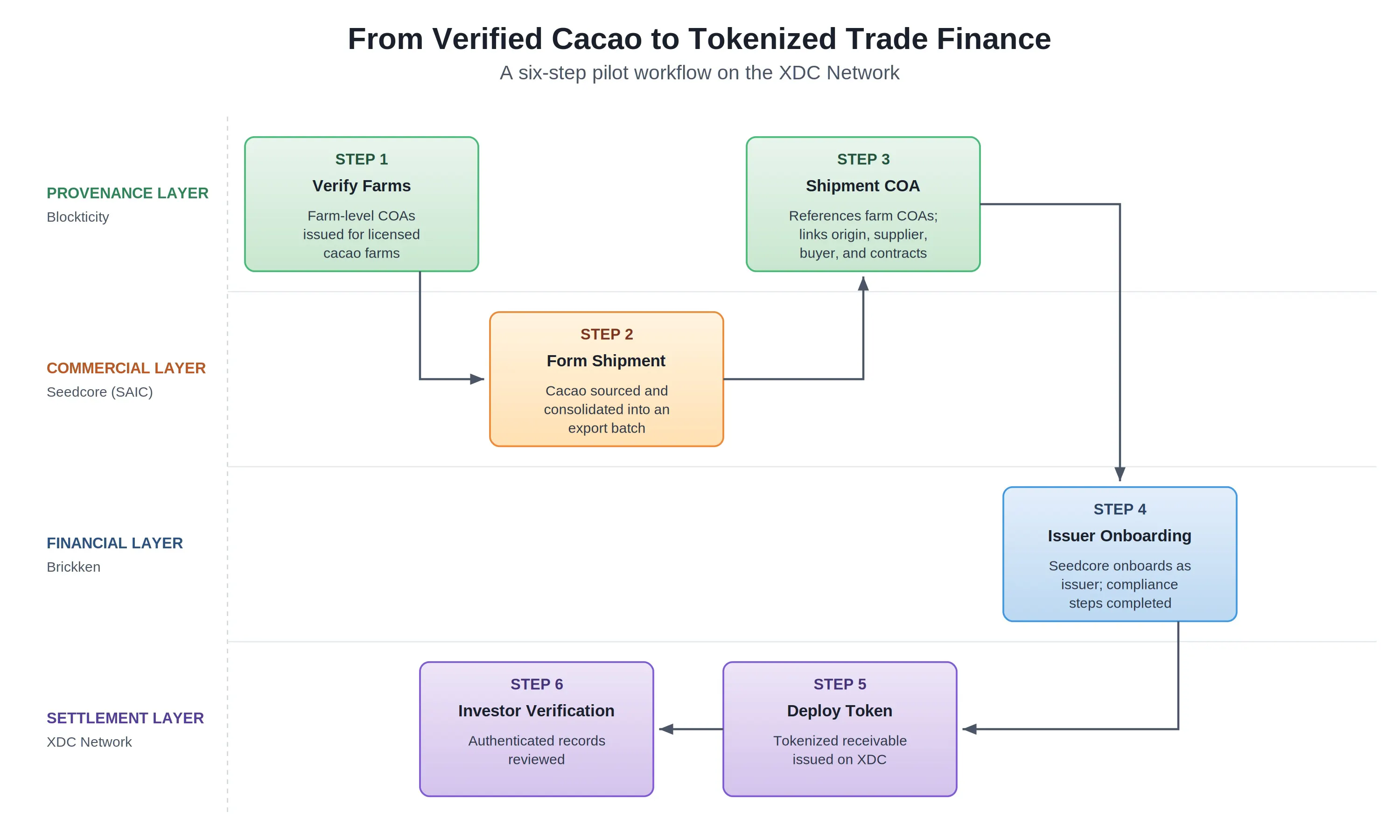
To make the orchestration easier to follow, the pilot can be viewed as a sequence of connected steps. Each participant played a specific role in moving the process from verified cacao provenance to a tokenized trade finance asset on XDC Network.
Verifying cacao farms. Blockticity issued farm-level COAs for the licensed cacao farms that supplied the crop.
Shipment formation. Seedcore sourced cacao from those verified farms and consolidated it into an export shipment.
Shipment-level COA. Blockticity created a shipment-level COA that referenced the farm COAs and connected the shipment to its origin, supplier, and supporting trade documents.
Issuer onboarding. Seedcore onboarded to the Brickken platform as an asset issuer and completed the required compliance steps.
Tokenized receivable on XDC. Certificates of Authenticity and receivables documents were used to deploy the tokenized asset on XDC.
Investor verification. Participants could review the authenticated records and verify the connection between the financial instrument and the underlying cacao shipment.
Conclusion
For years, real-world asset tokenization has been held back by an unspoken assumption: that the gap between paper-based, multi-party trade processes and on-chain financial instruments is too messy to bridge in any reproducible way. This pilot demonstrates otherwise.
Three outcomes stand out. First, provenance and finance were joined without being conflated. Blockticity's COAs did not become the receivable; they grounded it. The tokenized asset on XDC referenced authenticated records rather than re-creating them, preserving the integrity of each layer while making the link verifiable to anyone. Second, the workflow was navigable for every participant. A Philippine cacao exporter, an authenticity provider, a tokenization platform, and a Layer 1 network operated through their existing tools and obligations — including ASTM and EUDR-aligned authentication and platform-level compliance — rather than reorganizing around new ones. Third, the value proposition for the upstream economy is direct. When a smallholder farm's licensed status is anchored on-chain, and a shipment built from those farms backs a verifiable receivable, capital can move toward producers with materially less friction and materially more trust.
What the pilot proves is that the missing layer in real-world asset tokenization is not better tokens or faster chains, but verifiable connective tissue between physical commodities and the financial instruments that represent them. Brickken structures the offering, Seedcore anchors the commercial reality, and Blockticity certifies the underlying truth. XDC Network makes that connectivity load-bearing — a trade-finance-optimized Layer 1 where provenance records and financial instruments can reference each other natively, without translation.
The blueprint extends well beyond cacao. Coffee, cocoa, coconut, timber, fisheries, agricultural receivables, and shipment-backed credit all share the same foundational requirement — and now share a working pattern for meeting it.
Visit the XDC Foundation Medium page for more stories.